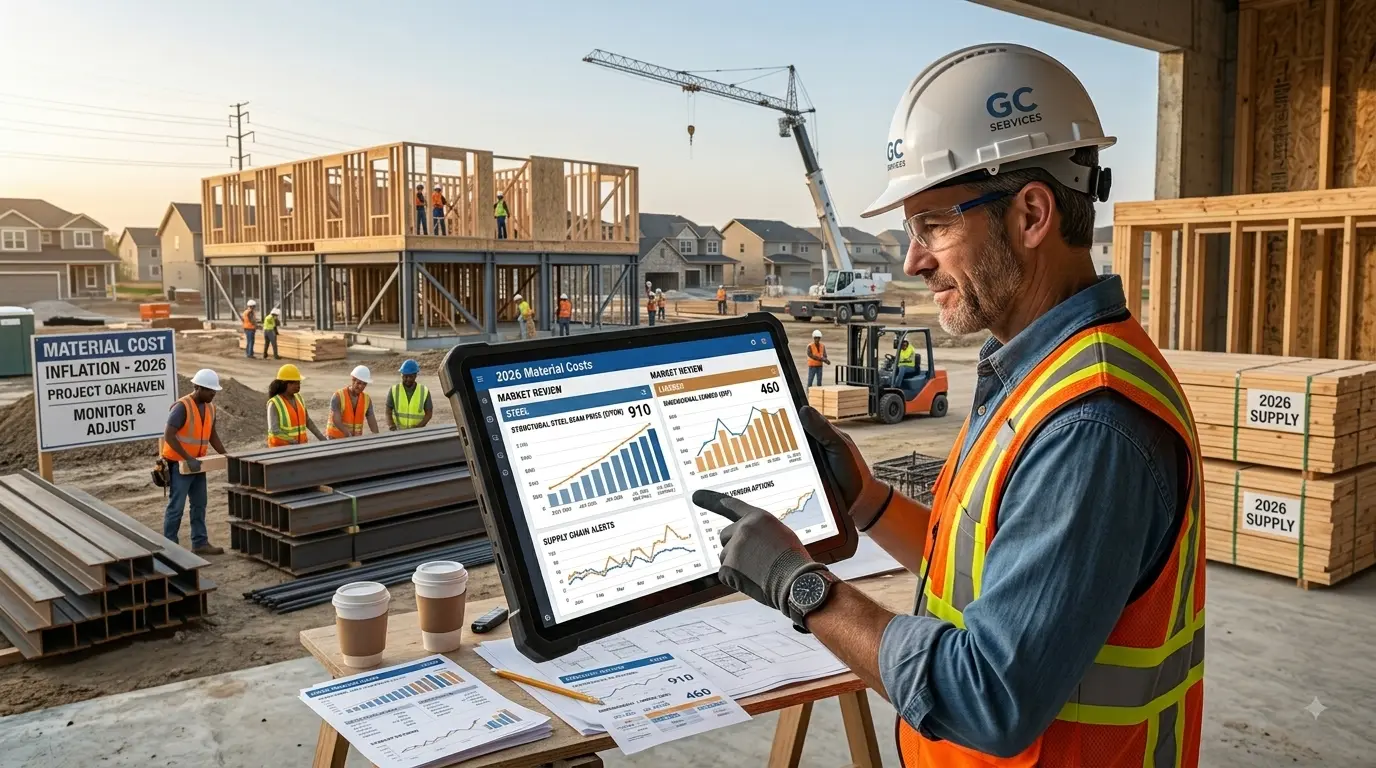

If a bid is still priced off last year’s numbers, it’s wrong. Material costs in 2026 have moved sharply since federal tariffs on steel, aluminum, copper, and lumber took full effect, and prices climbed at a 12.6% annualized rate during the first two months of 2026 alone — the fastest pace since the supply-chain disruptions of early 2022, according to an April 2026 industry cost analysis.
For GCs, that volatility shows up in one place: the gap between what a bid assumes materials will cost and what they actually cost by delivery day. This guide breaks down the current tariff landscape, how it’s reshaping bid estimating, and how real-time cost tracking software and disciplined change order documentation protect margins when material prices won’t hold still.
The 2026 Material Cost Landscape: Lumber, Steel & Tariff Impact
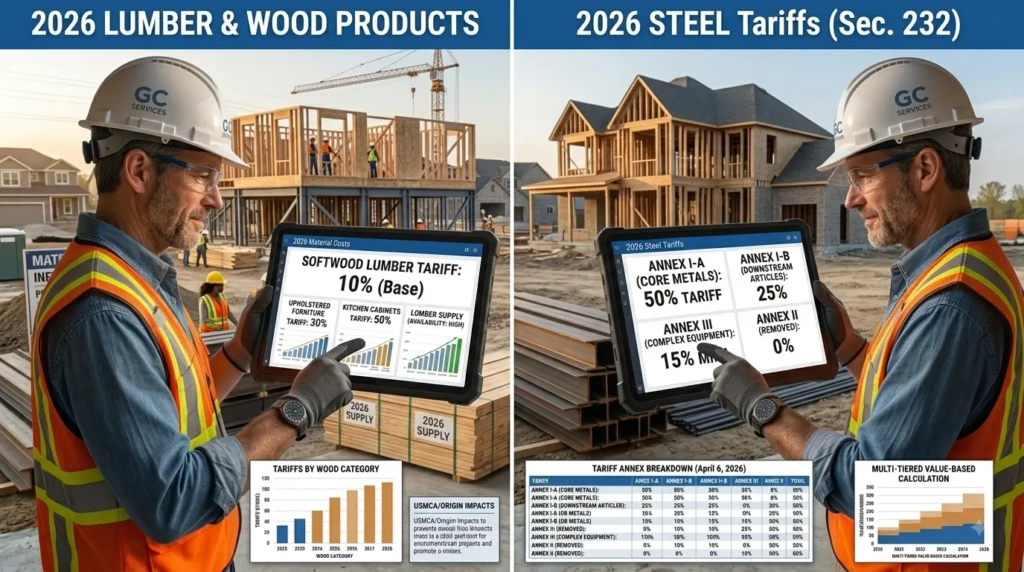
Understanding construction material costs in 2026 starts with the tariff rates actually in effect. As of April 2026, steel, aluminum, and copper items made entirely or mostly from those metals carry a 50% tariff, with derivative products at 25% and industrial or electrical equipment — transformers, panel boards, conduit systems — at 15%, according to a Q2 2026 construction cost outlook.
Softwood lumber carries a 10% tariff, with derivative products at 25%, and a global 10% baseline tariff remains in effect through July 2026. Combined, these lumber steel tariffs construction teams are budgeting around have pushed aggregate construction cost escalation to roughly 8% under current policy, with individual material categories ranging from 5% to 25% depending on tariff exposure.
A few figures worth putting directly in front of estimating and leadership teams:
- Steel, aluminum, and copper: 50% tariff on finished items made mostly of those metals; 25% on derivatives.
- Industrial and electrical equipment (transformers, panel boards, conduit): 15% tariff.
- Softwood lumber: 10% tariff; lumber derivatives: 25%.
- Nonresidential input prices: +12.6% annualized in early 2026 — the fastest pace since 2022.
- Aggregate construction cost escalation: roughly 8%, with some categories running as high as 25%.
The residential impact is real. The Brookings Institution calculated that current tariffs would add roughly $30 billion to the cost of residential construction investments — about $17,500 per new home. A figure that could contribute to 450,000 fewer homes being built through 2030, according to Brookings data cited in an April 2026 industry report. For residential GCs, that’s not an abstract number pulled from the headlines — it’s real pressure on every framing package and finish schedule.
How Tariffs Are Reshaping Bid Estimating
Tariff rates have shifted enough times since 2025 that an estimate written even a few months ago can no longer be trusted at face value. The core problem isn’t just higher prices — it’s volatility between the day a bid goes out and the day materials actually get delivered.
That volatility is pushing GCs and estimators toward a few adjustments in how bids get built:
- Indexed or quarterly-reset pricing clauses instead of fixed material line items locked at bid time.
- Maintaining at least two qualified suppliers per critical scope, so a single tariff-driven price spike doesn’t strand a project.
- Shorter validity windows on quotes given to homeowners, paired with clear language about material-cost contingencies.
- Re-pricing tariff-exposed trades — structural steel, electrical, HVAC — separately from more stable scopes like interior finishes.
None of this works, though, if a GC can’t see actual cost movement against the original budget in real time — which is exactly the gap cost tracking software is built to close.
Protecting Margins with Real-Time Construction Cost Tracking Software
A spreadsheet built at bid time is a snapshot, not a living record. Construction cost tracking software replaces that snapshot with a running comparison of actual material and labor costs against the original budget — so a GC sees a cost overrun the week it happens, not at project closeout when there’s nothing left to do about it.
A cost tracking system worth relying on in 2026’s tariff environment should:
- Update job costing versus budget in real time as invoices and material purchases come in.
- Flag a line item automatically when actual spend diverges meaningfully from the original estimate.
- Break out tariff-exposed materials (steel, lumber, copper, electrical components) separately from stable-cost line items.
- Give every project stakeholder — GC, PM, and accounting — the same live number instead of three different spreadsheets.
This is precisely where Constant Builder’s job costing tools apply directly: GCs using the platform to get instant visibility into job costing versus budget, which is what turns a material price spike into a manageable line-item adjustment instead of a margin surprise discovered after the job is done.
Change Order Documentation as Margin Protection
When a material price jump forces a mid-project adjustment, the difference between absorbing that cost and passing it through cleanly usually comes down to documentation. A verbal agreement with a homeowner about a steel price increase means nothing if it’s disputed at final invoicing.
- Time-stamp every material price change with the supplier quote attached, not just a verbal note.
- Route tariff-driven cost increases through a formal change order — never a quiet adjustment buried in a later invoice.
- Get homeowner sign-off on the change order before ordering the affected materials, not after.
- Keep the change order tied directly to the specific budget line item it affects, so the audit trail is clear at closeout.
Done well, this isn’t just paperwork — it’s the documentation that protects a GC’s margin and reputation simultaneously when a homeowner asks why a number changed mid-build.
How Constant Builder Helps GCs Adapt Estimates Mid-Project
Constant Builder’s estimating tools factor material costs, labor rates, equipment needs, and overhead into every bid from the start, and connect directly to job costing data once a project breaks ground — so a GC isn’t estimating in one tool and tracking actuals in another. When a subcontractor or supplier invoice comes in above budget, it shows up against the original estimate immediately, not at the next manual reconciliation.
Change orders tied to material price increases move through the same platform used for invoicing and payments, so the documentation, the homeowner sign-off, and the updated budget line all live in one connected record — instead of a change order in one tool, an invoice in another, and a budget spreadsheet nobody’s updated in weeks.
Don’t absorb another tariff surprise. See how Constant Builder connects estimating, job costing, and change orders in one place
FAQ
Federal tariffs are the primary driver. Steel, aluminum, and copper items carry a 50% tariff, softwood lumber carries a 10% tariff, and nonresidential input prices rose at a 12.6% annualized rate in early 2026 as a result, per industry cost tracking data.
Estimates vary by category, but aggregate construction cost escalation is running around 8% under current tariff policy, with some tariff-exposed categories — particularly structural steel and copper — seeing increases as high as 25%.
Construction cost tracking software compares actual job costs — materials, labor, subcontractor invoices — against the original budget in real time, flagging overruns as they happen instead of at project closeout.
The most effective combination is real-time cost tracking to catch price divergence early, indexed or quarterly-reset pricing on tariff-exposed materials, and disciplined change order documentation so cost increases are approved and billed correctly instead of absorbed quietly.
Current tariff policy — including the global baseline tariff in effect through July 2026 — suggests continued volatility rather than a clear reversal, which is why GCs are increasingly building pricing flexibility directly into their estimating and contract terms.
Ready to Stop Losing Margin to Material Price Swings?
Constant Builder connects estimating, real-time job costing, and change order documentation in one platform — so a tariff-driven price jump becomes a tracked, billed adjustment instead of an absorbed loss.