
How AI Is Solving the Construction Labor Shortage in 2026
The construction labor shortage isn’t an exaggeration GCs swap at trade shows — it’s a documented gap of 349,000 net new workers the industry needs just to keep supply and demand in balance, according to a January 2026 model from the Associated Builders and Contractors (ABC).
For most GCs, hiring alone won’t close that gap fast enough. That’s where AI construction scheduling and automation come in — not as a replacement for skilled trades, but as a way to get more finished square footage out of every crew already on the payroll. This guide covers the real scale of the labor shortage, why traditional hiring can’t solve it alone, and how AI-powered tools are helping GCs treat the construction workforce crisis as a solvable operations problem instead of a permanent ceiling on growth.
FEELING THE CRUNCH? Try Constant Builder's AI assistant without adding headcount →
The Scale of the 2026 Labor Shortage
The numbers behind the construction labor shortage data are specific, and they come from one of the industry’s most closely watched forecasting models. ABC’s Chief Economist Anirban Basu projects the industry needs to attract 349,000 net new workers in 2026, rising to 456,000 in 2027 as construction spending growth resumes.
What makes this year’s projection different is the driver behind it. Basu notes that a majority of 2026’s new-worker demand traces back to retirements rather than growth in construction spending — meaning the shortage isn’t tied to a booming market that could cool off. It’s structural, driven by an aging workforce leaving faster than new tradespeople are entering.
A few data points worth keeping in front of your leadership team:
- 349,000 net new workers needed in 2026 just to keep labor supply and demand in equilibrium.
- 456,000 additional workers projected for 2027 as spending growth resumes.
- Retirements — not project growth — account for most of this year’s worker demand, per ABC.
- Megaprojects like AI data centers and semiconductor plants are pulling electricians and mechanical trades away from residential and general commercial work.
For residential GCs specifically, that last point matters: the specialized trades a home build depends on are being drawn toward higher-paying megaprojects, tightening an already thin labor pool in local markets.
Why Traditional Hiring Alone Won’t Close the Gap
Posting more job listings won’t fix a structural shortage. A few forces are working against traditional hiring as a standalone solution to the construction workforce crisis:
- Training pipeline lag — it typically takes several years to develop a journeyman-level tradesperson, far slower than the pace at which experienced workers are retiring.
- Regional mismatches — labor is tightest in exactly the high-growth metros where GCs need it most, while other regions may have more available workers than local demand.
- Immigration policy uncertainty — shifting enforcement and visa policy have made the flow of workers into the trades less predictable year to year.
- Wage competition from megaprojects — data center and manufacturing buildouts can outbid residential GCs for the same specialized trades.
None of these forces are things an individual GC can fix through recruiting budget alone. What is within a GC’s control is how much output they can get from the crews and subs they already have — which is exactly where AI construction scheduling changes the math.
How AI Construction Scheduling and Automation Multiply Existing Crews
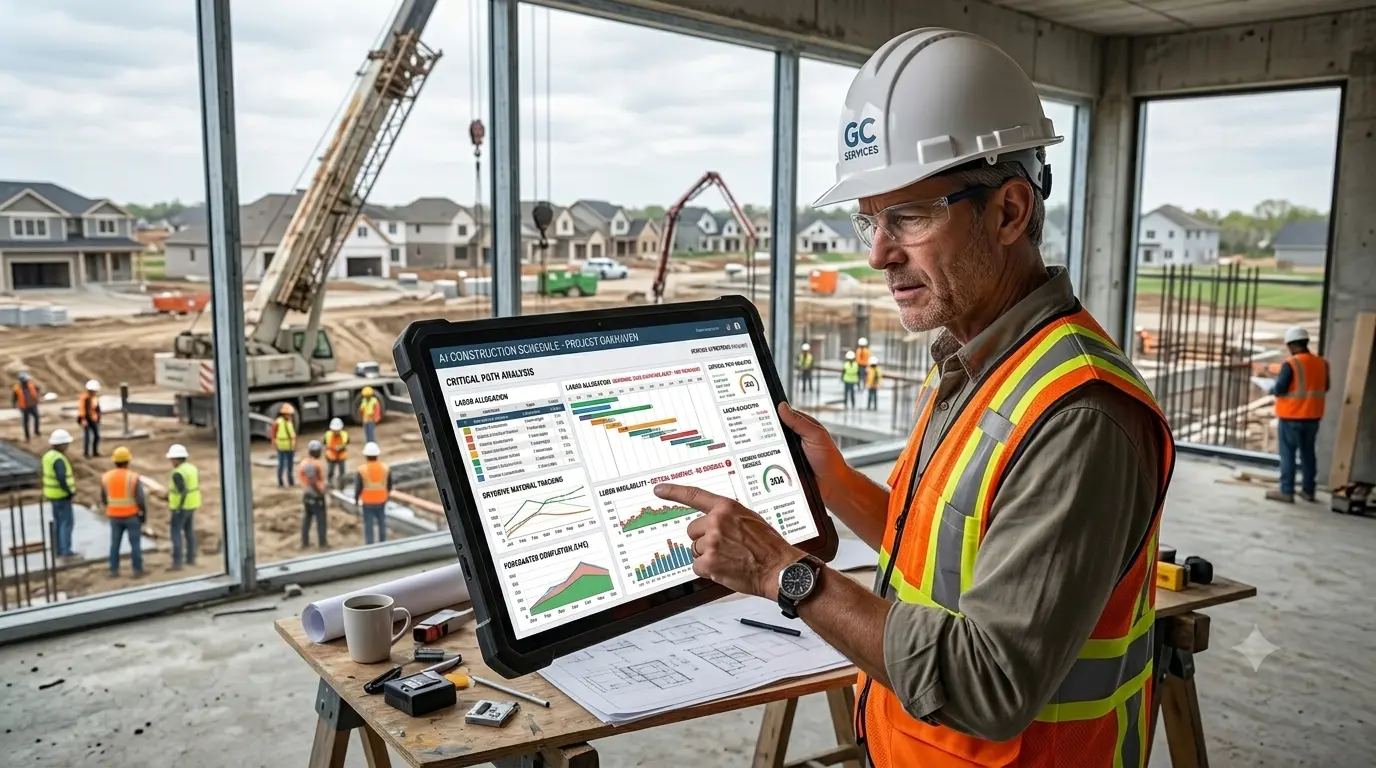
Instead of trying to outhire a structural shortage, more GCs are turning to AI construction scheduling to get more finished work out of the crews and subs already on their roster. Rather than a static calendar that someone has to manually update every time a delay hits, an AI-driven schedule adjusts itself as conditions change.
In practice, that looks like:
- Automatically reallocating a sub’s open days to another job when weather or material delays free up their schedule.
- Flagging scheduling conflicts before they cause a crew to show up with nothing to do.
- Matching sub availability and trade specialty to open job slots faster than a human dispatcher juggling multiple spreadsheets.
- Surfacing the next highest-priority task automatically, instead of relying on a superintendent to remember everything that’s pending.
The effect isn’t hypothetical — it’s throughput. A crew that isn’t standing idle waiting on a schedule update is, functionally, a bigger crew. AI construction scheduling doesn’t add headcount; it removes the dead time that made the existing headcount less productive.
Automated Record-Keeping as a time-savings Tool for GCs
Scheduling isn’t the only place hours disappear. Superintendents and GCs routinely lose several hours a week to manual daily logs, chasing down photo documentation, and re-entering the same project updates across texts, email, and spreadsheets.
Automated record-keeping — daily logs generated from field input, photos tagged and organized automatically, status updates that sync across the GC, sub, and homeowner without manual re-entry — gives that time back. For a GC managing 15 to 20 builds a year, even five recovered hours a week per superintendent adds up to meaningful additional project capacity, without a single new hire.
That’s the quiet half of solving the construction workforce crisis: it’s not only about doing more field work with the same crews, it’s about spending less of every crew leader’s week on administrative tasks that software can handle automatically.
Case in Point: Constant Builder’s AI Assistant in the Field
Constant Builder’s AI assistant is built around this exact problem. It learns a GC’s workflow and surfaces the most important task at any given moment — from a schedule conflict that needs resolving to a sub who hasn’t confirmed tomorrow’s job — instead of leaving that prioritization to memory. GCs currently using Constant Builder report managing 15 to 20 home builds per year without the chaos that volume used to require.
Because the AI assistant works from the same mobile app GCs already use in the field — including using voice commands — it doesn’t ask a superintendent to learn a second system on top of an already full day. It replaces the mental overhead of tracking a dozen moving projects with a tool that does the tracking automatically.
What GCs Should Do Now to Stay Ahead of the Construction Workforce Crisis
With ABC projecting an even larger 456,000-worker gap in 2027, the construction workforce crisis isn’t going to resolve itself without deliberate actions by leaders of GC and Subcontractor organizations. Here are some practical steps GCs can take now:
- Audit where superintendent hours actually go for one week — most GCs are surprised how much time goes to admin instead of production.
- Adopt AI construction scheduling before the gap widens further in 2027, not after a bad season forces the decision.
- Cross-train existing crews on adjacent tasks to add scheduling flexibility without new hires.
- Choose software that scales with project volume, not headcount — the goal is doing more with the same team, not managing more tools.
DON’T WAIT FOR NEXT YEAR’S BIGGER GAP. Every season without AI-driven scheduling is lost throughput you can’t get back. See what Constant Builder can do to help you scale the business without having to scale your headcount proportionally and improve your business profitability.
FAQ
1. How big is the construction labor shortage in 2026?
The construction industry needs an estimated 349,000 net new workers in 2026 to keep labor supply and demand in balance, according to ABC’s January 2026 model, with that figure rising to 456,000 in 2027.
2. Can AI actually replace construction workers?
No — AI construction scheduling and automation tools don’t replace skilled trades on the job site. They eliminate the scheduling downtime and administrative overhead that make existing crews less productive, effectively increasing output per person without adding headcount.
3. What is AI construction scheduling?
AI construction scheduling uses software to automatically adjust crew and subcontractor schedules in response to real-time conditions — weather delays, material lead times, and sub availability — instead of relying on a manually updated calendar.
4. Will the construction workforce crisis get worse after 2026?
Yes, ABC’s model projects the worker gap will grow to 456,000 in 2027 as construction spending growth resumes, up from 349,000 in 2026 — meaning GCs who adopt efficiency tools now will be better positioned than those who wait.
5. How can small GCs afford AI tools built for large firms?
Platforms like Constant Builder are built specifically for small-to-mid-volume residential GCs, not enterprise commercial contractors — so AI scheduling and automation are available without the per-user pricing or lengthy implementation typical of large-firm software. Constant Builder’s success team can provide ROI calculations for your particular business that show that your Constant Builder subscription fees pay for themselves in less than nine months more importantly you realize increased productivity and deliver builds more reliably from day one.
Ready to Solve Your Own Labor Gap?
The construction labor shortage in 2026 isn’t going away, but it doesn’t have to cap how much work your business can take on. Constant Builder’s AI assistant handles the scheduling and admin work eating into your crews’ productive hours.