
All-in-One Construction Software: The Complete Construction Management Platform Contractors Need Today
Construction projects keep getting more complicated. That’s just the way it is.
You’ve got crews to manage, subs to schedule, budgets to protect, and clients who want updates every other hour. Somehow, you’re supposed to keep all of it straight while jumping between spreadsheets, text messages, and whatever random app someone on the team decided to use last week.
Sound familiar?
A lot of contractors still run things this way. But more of them are starting to realize there’s a better option. They’re switching to all in one construction software—a single platform that handles the whole job from start to finish.
Let’s walk through why that matters and what you should actually look for.
What Exactly Is All in One Construction Software?
Construction projects keep getting more complicated. That’s just the way it is.
You’ve got crews to manage, subs to schedule, budgets to protect, and clients who want updates every other hour. Somehow, you’re supposed to keep all of it straight while jumping between spreadsheets, text messages, and whatever random app someone on the team decided to use last week.
Sound familiar?
A lot of contractors still run things this way. But more of them are starting to realize there’s a better option. They’re switching to all in one construction software—a single platform that handles the whole job from start to finish.
Let’s walk through why that matters and what you should actually look for.
What Exactly Is All in One Construction Software?
Here’s the simplest way to put it. Instead of using one tool for estimates, another for schedules, a third for team chat, and maybe a notebook for tracking materials, you get one system that does it all.
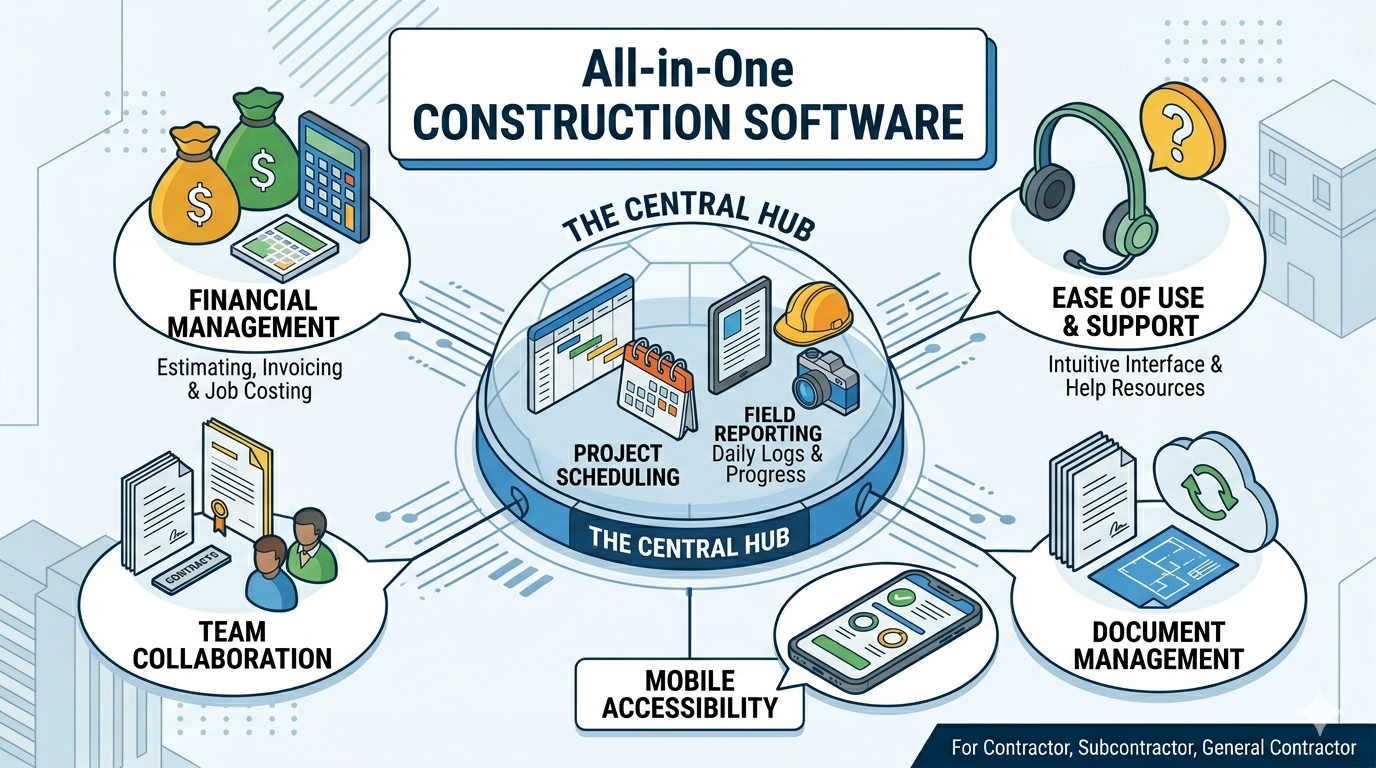
Think of it as your project’s control center. From the day you bid a job to the moment you hand over the keys, everything lives in the same place.
Most platforms worth your time include:
- Project planning and scheduling tools
- Task assignments for your crew and subs
- Budget tracking and expense management
- Document storage (drawings, contracts, reports)
- Team communication (so you’re not texting 15 people individually)
- Progress tracking with photos and updates
- Reporting and analytics to see how you’re really doing
When everything runs through one system, you stop chasing down information and start actually building.
Why Contractors Are Moving to All-in-One Construction Management Software
If you’ve been in this business for more than a few years, you know the pain. The office has one set of numbers, the field has another, and somehow things fall through the cracks.
That’s where all in one construction management software changes the game. It gives everyone the same view of the project.
Here’s what that actually looks like on a daily basis:
No more digging for files. Every document, every update, every report lives in one spot. You don’t have to scroll through old emails or ask five people for the same drawing.
Communication that actually works. When your office team, site guys, and subs are all talking in the same place, nobody gets left out. No more “I didn’t get that message” excuses.
You catch problems early. Real-time updates mean you see delays or budget issues when you can still do something about them—not after it’s too late.
Money gets easier to track. Materials, labor, change orders—it’s all right there. You know exactly where you stand financially on every job without waiting for end-of-month reports.
What Makes a Complete Construction Management Platform?
A lot of software calls itself construction management, but honestly, some of it is just a to-do list with a fancy logo. A real complete construction management platform supports the entire life of a project, not just one piece of it.
Here’s what that means:
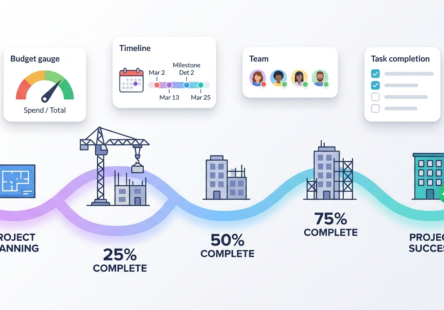
Planning that actually works. You can lay out tasks, set timelines, and see how delays in one area will ripple through the rest of the job. It helps you stay ahead instead of always playing catch-up.
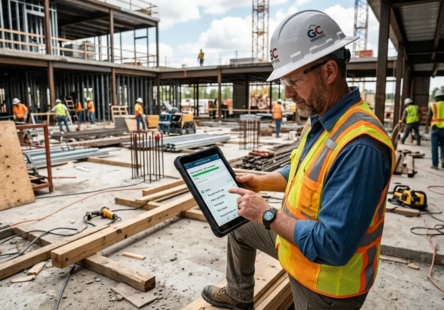
Field updates that don’t require a report. Your guys on site can snap photos and log progress right from their phones. You see what’s happening without having to track them down at the end of the day.
Documents that are actually findable. No more stacks of paper or shared drives that nobody can navigate. Everything is organized and easy to pull up when you need it.
Conversations that stay with the job. When discussions, approvals, and questions live inside the platform, you don’t lose context. New team members can get up to speed without reading through months of text message chains.
Reports that tell you the truth. Good platforms let you generate reports that show what’s working and what’s not—so your next job runs smoother than the last.
Why Stick With One Platform Instead of Multiple Tools?
Look, nobody wakes up excited to switch software. It’s a hassle, and there’s always a learning curve. But here’s the thing—juggling five different tools is a bigger hassle, and it’s costing you more than you probably realize.
One platform saves you time. You’re not logging in and out of different apps or copying data from one place to another.
You actually see the big picture. When everything is integrated, you can look at one screen and know exactly where every job stands.
There’s less room for error. Mistakes drop when everyone is working from the same information.
You can actually grow. Adding more projects doesn’t have to mean adding more chaos. A good platform scales with you.
How to Pick the Right Software (Without Regretting It Later)
Not all all in one construction software is built the same. Before you commit to anything, run through these questions:
- Is it actually easy to use? If your crew hates it, they won’t use it. Period.
- Can your guys access it from their phones? They’re not sitting at a desk.
- Does it give you real-time updates? Old information is useless information.
- Will it work with the way you already do things? You shouldn’t have to completely reinvent your workflow.
- Can it handle more work as you grow? You don’t want to switch again next year.
The right software should make your life easier, not harder. If it feels like a headache from day one, walk away.
Why a Free Trial Makes Sense
I get it. Committing to new software feels like a big step. You’re not sure if it’ll work for your team, if your guys will actually use it, or if it’ll make enough difference to justify the switch.
That’s exactly why free trials exist.
A trial lets you:
- Click around and see if the interface makes sense
- Run a real project through it and see what breaks
- Get your team’s honest feedback without spending a dime
- Figure out if it actually saves you time or just adds more steps
You’re making a decision based on real experience, not a sales pitch. That’s the only way to do it.
One Platform Worth Looking At
If you’re tired of chasing down information and ready to try something that actually works, take a look at Constant Builder.
It was built for contractors who are done with the spreadsheet-and-text-message chaos. You get planning tools, team communication, document storage, progress tracking, and reporting—all in one place. No jumping between apps. No asking five people for the same update.
Whether you’re framing houses or running commercial jobs, having a complete construction management platform under one roof changes how you work.
You can try it yourself right here:
👉 https://constantbuilder.com/
Conclusion:
Construction isn’t getting simpler. Deadlines keep shrinking, owners keep demanding more, and margins keep getting tighter.
The contractors who are staying ahead aren’t the ones working harder—they’re the ones working smarter. They’ve stopped fighting with spreadsheets and started using all in one construction software that actually helps them build.
A complete platform won’t swing a hammer for you. But it will keep your projects organized, your team communicating, and your budget on track. And with all in one construction software, that level of control becomes far easier to achieve.
In today’s market, the difference between winning and losing often comes down to efficiency. That’s why forward-thinking teams are replacing fragmented tools with one unified system that brings scheduling, budgeting, documents, and communication into one place.
And these days, that’s half the battle.
FAQ
Yes—all in one platforms eliminate data silos, reduce login fatigue, and sync schedules with billing automatically, saving contractors 15-20 hours/week.
Saves 60% admin time, eliminates app switching, syncs schedules with billing, prevents time theft via GPS, and keeps owners/subs updated automatically.
GCs with 3+ jobs, small contractors outgrowing spreadsheets, residential builders needing owner portals, commercial teams managing subs.
Constant Builder's all-in-one platform serves San Antonio GCs with job costing, crew management, and owner photo updates.
- Cloud-based platforms like Constant Builder offer scalable pricing that grows with your Houston business, starting with essential features and adding capabilities as you expand, without requiring expensive hardware or IT staff, and supporting unlimited projects as your company grows.
Absolutely. For builders in rapidly growing markets like Austin or San Antonio, software prevents the loss of context that happens in long text chains and ensures that homeowners receive professional, timely updates, which is critical for maintaining a competitive reputation.
In the U.S., all in one construction software helps teams manage complex projects, coordinate multiple subcontractors, track costs accurately, and maintain visibility from office to job site.
Houston contractors should look for features like task and subcontractor scheduling, budget tracking, mobile access for field teams, document storage, and a homeowner or client portal to share progress and costs in real time.